Turning Social Media Data Into Actionable Product Feedback

Customers regularly share frustrations, workarounds, and questions online, yet much of this feedback never reaches product teams. Instead, teams rely on surveys, interviews, and review platforms, which provide value but require effort and often capture delayed reactions. Social media offers a different signal: unprompted, real-time, and large-scale. Discussions on Reddit or spikes in tweets can reveal issues faster than formal research cycles. The challenge is not access but organization, as insights often remain siloed instead of informing product decisions.
Where Social Media Reveals Product Signals
Product feedback rarely arrives labeled as such. A frustrated tweet about a checkout error, a Reddit thread comparing your pricing to a competitor's, a TikTok creator showing an unexpected workaround - these are all signal, just scattered across platforms that most teams aren't monitoring systematically.
Each channel tends to surface different problems. X (formerly Twitter) catches real-time frustration, especially around outages or feature regressions. Reddit threads, particularly in niche subreddits, expose deeper onboarding friction and missing features because users there write at length. YouTube comments and creator content reveal how people actually use a product versus how it was intended. LinkedIn conversations flag positioning confusion among professional buyers. App Store and Google Play reviews are underrated sources of recurring bug reports, often with version-specific detail.
The value isn't in any single channel. One viral complaint might reflect one bad day. Patterns across Reddit, review ecosystems, and Instagram comments over six weeks tell you something real.
How To Turn Raw Mentions Into Usable Feedback
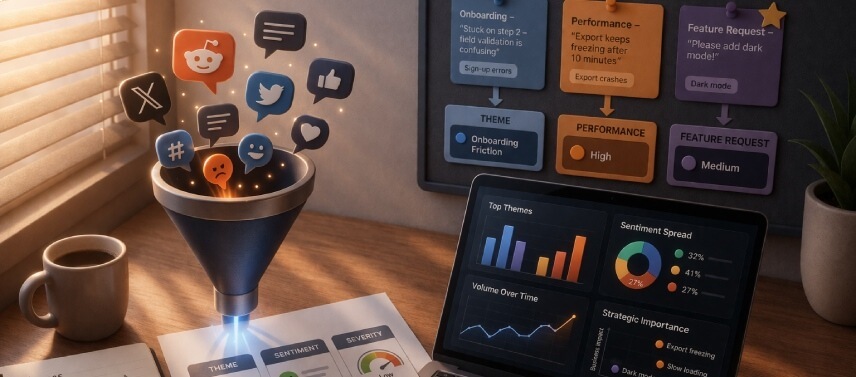
Scattered posts become structured insight only when you impose a consistent tagging system on them. Start by grouping mentions into broad themes - onboarding friction, feature requests, performance complaints - then break each theme into specific issue types. A comment like "the export function keeps freezing" belongs under performance, not general dissatisfaction.
Separating sentiment from severity matters more than most teams expect. A single tweet from a power user describing a workflow-breaking bug carries more weight than fifty complaints about button color. Frequency tells you what's common; strategic importance tells you what to fix first.
Raw social data also needs validation before it shapes roadmap decisions. Cross-reference patterns against support ticket volume, NPS verbatims, or usage analytics. If a complaint appears on Twitter but nowhere in support data, context is probably missing.
Automated sentiment tools are useful for scale, but they misread sarcasm and nuance regularly. Human review of flagged clusters - even a sample of 50 posts - catches what algorithms miss. Treating the loudest voices as representative is the most common and most costly mistake product teams make.
How Product Teams Can Act on Insights Faster
Collecting social data is the easy part. The harder question is whether it ever reaches the people building the product - and whether it arrives in time to matter.
When social listening feeds directly into sprint planning or roadmap reviews, teams stop waiting on quarterly research cycles. A spike in complaints about a confusing onboarding step, for instance, can surface within days and get triaged before it compounds into a churn problem. That's a meaningful compression of the usual research lag.
Prioritization becomes sharper, too. Repeated mentions of the same friction point carry more weight than a single support ticket. Teams can rank fixes by complaint volume, sentiment intensity, or which user segment is loudest - all signals that traditional surveys rarely capture this quickly.
Closing the loop matters as much as acting on the insight. When a change ships, acknowledging it publicly - even briefly - builds credibility with the customers who flagged the issue.
Consider a real pattern: a SaaS company notices dozens of posts in March 2024 complaining that their mobile export feature crashes on iOS 17. Within three weeks, the team ships a patch and replies to several of those users directly. Complaints drop, and app store ratings recover within a month.
Social Listening Works Best When It Drives Decisions
The job of collecting mentions and monitoring sentiment is only one small step. Teams that really want to make a difference in product will accept social data as one input among many that they verify by use of interviews, support tickets, and in-house analytics. A sudden increase in complaints is more relevant if it pertains to decreases in conversion. Real-time signals may seem urgent, but decisions led by either of them cause more damage in the long run. Separate points of noise are not very important, but points should be dealt with as patterns. Social insights are not of much value if long-term planning can't be reached.
With the expert opinion from our friends:

Popular Tweets
Connect with us during #CannesLions2024 to learn more about how X is bringing it all together in an open marketplace for ideas, conversation and commerce that accelerates self-expression for all. pic.twitter.com/HhsSegxzQp
— Business (@XBusiness) June 10, 2024